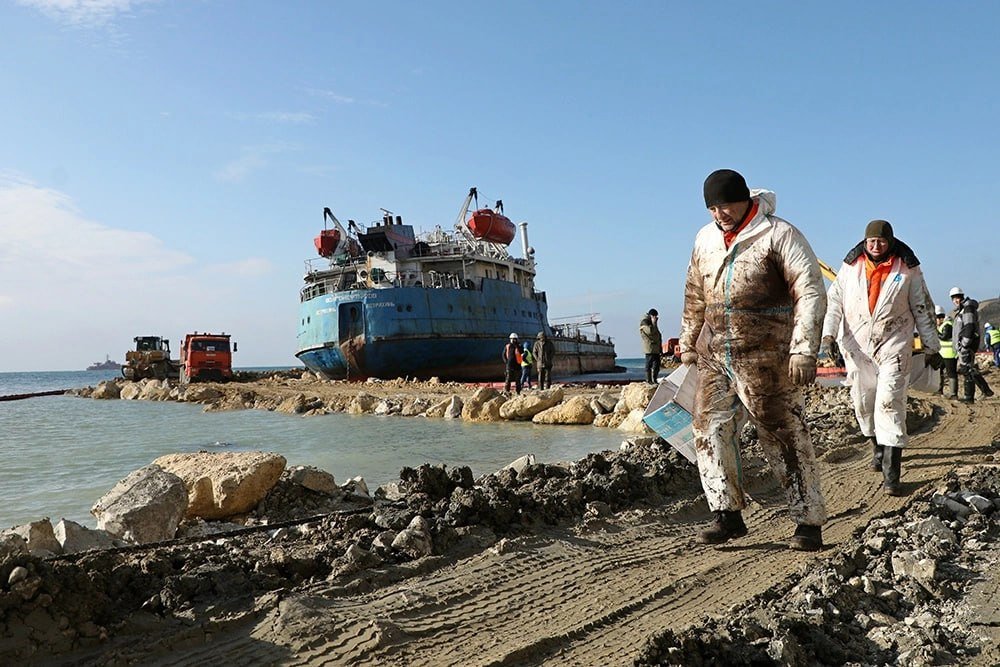

Fuel oil is leaking again from the wreck of the tanker Volgoneft-239 in the Kerch Strait, a year and a half after the vessel broke apart in a December 2024 storm that triggered one of the Black Sea’s worst environmental disasters in decades. Satellite imagery reviewed by the open-source project Sky Eye in early July 2026 showed oil slicks stretching several kilometers from the wreck’s bow section, and Greenpeace confirmed to the BBC that discharges had been occurring regularly since the start of the month. Residents of the Temryuk district in Krasnodar Krai reported contamination reaching the shore in mid-July.
Russian authorities had pledged to install protective steel cofferdams around the wrecks of both Volgoneft-239 and its sister vessel Volgoneft-212, then pump out the remaining fuel oil and eventually raise the hulks. According to the environmental group Bellona, all three cofferdams were in place by early February 2026, but the pumping stage was still only in planning at that point. Sky Eye suggested the renewed leak may be linked to that work combined with rising Black Sea water temperatures — though the precise cause has not been established.
The December 2024 accident killed one crew member and spilled an estimated several thousand tonnes of heavy fuel oil, contaminating coastline in Krasnodar Krai, occupied Crimea, and reportedly reaching Georgia’s shore. Roughly 150,000 tonnes of oil-contaminated sand were collected in the cleanup that followed, and a scientist at the Russian Academy of Sciences’ Institute of Water Problems called it the country’s most serious environmental disaster of the century so far.
Courts order huge payouts, but compensation lags
Rosprirodnadzor, Russia’s environmental watchdog, won judgments against the tankers’ owners, Kama Shipping and Volgatransneft, totaling roughly 85 billion rubles, which the Arbitration Court of the North Caucasus District upheld on appeal in spring 2026. The Krasnodar Regional Court separately upheld a methodology used to calculate a further 34.1 billion rubles in damages to wildlife, rejecting Volgatransneft’s challenge in March 2026.
Yet the scale of the judgments has not translated into actual payouts. Shipowners are entitled to cap their liability through a limitation fund under Russia’s Merchant Shipping Code; according to available reporting, courts in this case applied the 2001 Bunker Convention rather than the more directly relevant 1992 Civil Liability Convention for oil-cargo spills. Lawmaker Alexei Kurinny said last year that the tankers’ pollution coverage topped out at around $30 million — far below the roughly $300 million in environmental damage estimated at the time by experts consulted by Forbes.
Compensation for occupied Crimea barely features in these proceedings. Local Russian-installed authorities there have announced a considerably smaller sum — according to the source material reviewed, on the order of a few million rubles — described as covering costs tied to a contaminated-soil storage site near Shchyolkine, rather than compensation to residents or businesses. This detail could not be independently confirmed through other open sources.
Questions around a contractor
Court filings from the Krasnodar arbitration proceedings identify a Crimea-based firm, “VK Glubina,” among the entities involved in the cofferdam and pumping work. Its registration structure — according to available information, the company is registered under two identical entries with different codes — raises questions about its ultimate beneficiaries that open registries do not currently answer. How and on what terms the contract was awarded remains unclear; the source that first reported the company’s involvement does not disclose its methodology, so broader claims about its connections could not be established.
A wider pattern: fake insurance across the shadow fleet
The Kerch Strait spill is part of a broader, independently documented problem involving the shadow fleet of tankers carrying sanctioned oil. Analysts estimate more than 1,600 vessels were involved in such transport during 2025–2026 — nearly a fifth of global tanker tonnage.
One well-documented case involves a purported German insurer, “Seaguard P&I,” which Ukraine’s foreign intelligence service determined does not exist as a legitimate company, according to documents reported by Bloomberg in April 2026; the address listed for the firm corresponded to a residential building. At least five sanctioned tankers used Seaguard certificates, including the Paz (IMO 9233765), which was carrying roughly 140,000 tonnes of Russian oil from Murmansk toward China in March 2026. A related vessel, the Deyna, was seized by French authorities in March 2026 on suspicion of sailing under a false flag. The International Group of P&I Clubs, covering about 90 percent of world tonnage, has stopped insuring shadow-fleet vessels altogether, pushing operators toward such schemes or toward Russian state-backed reinsurance carrying sanctions-exclusion clauses that void coverage exactly when a claim is needed.
British parliamentary estimates put the cleanup cost of a single major shadow-fleet spill at close to a billion pounds, a bill that falls on the coastal state if no valid insurance exists. The Kerch Strait case is a working example of how that plays out: despite record court judgments, actual recovery has been slow, and a growing number of shadow-fleet tankers are being reflagged to Russia, which would likely route future compensation disputes into Russian courts.
What remains unknown
No timeline has been disclosed for completing the pumping operation, and no accounting has been published for the roughly 5.8 billion rubles reportedly allocated for cofferdam construction. Russia’s own data submitted to the International Oil Pollution Compensation Fund shows substantially smaller collected volumes than domestic Russian reporting on the same cleanup — the exact scale of that discrepancy requires further documentation before it can be stated with confidence.