
An investigation into the chain of events and the key figures behind the reversal
The collapse of the restrictions: from isolated concessions to a systemic shift
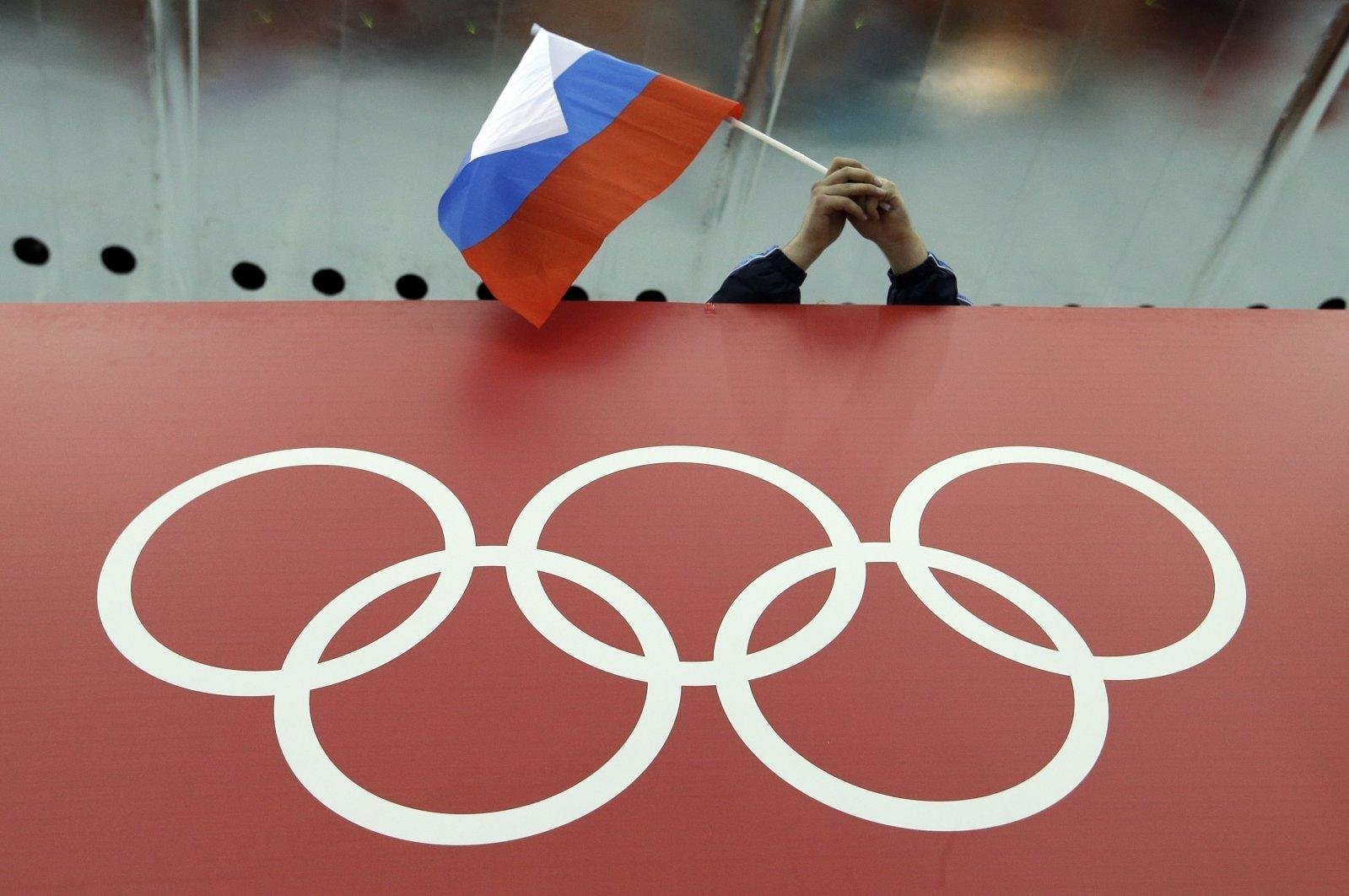
At the beginning of 2026, Russia’s sporting isolation following 2022 still appeared to be an established status quo: athletes were allowed to compete individually under neutral status, without the national flag or anthem, and under strict controls imposed by international federations.
Over the first seven months of 2026, however, that framework began to unravel, piece by piece.
The timeline is striking.
February 2026 — European Aquatics allows Russian and Belarusian athletes to compete at junior level under their national flags.
April 2026 — World Aquatics, which governs swimming, diving, water polo and artistic swimming, fully lifts restrictions on senior national teams, allowing them to compete with their flags and anthems.
May 2026 — the International Gymnastics Federation removes restrictions that had been in place for more than four years. At the same time, the IOC recommends that federations lift restrictions on Belarusian athletes.
Early June 2026 — the International Fencing Federation (FIE) removes all restrictions on senior athletes from Russia and Belarus, allowing them to compete with national flags and anthems at the World Championships in Hong Kong on July 22–30.
July 7, 2026 — the IOC itself temporarily restores the membership of the Russian Olympic Committee, which had been suspended since October 2023 after incorporating sports organizations from Russian-occupied territories of Ukraine.
July 8–9, 2026 — the International Volleyball Federation (FIVB) becomes the first major federation in a team sport to allow Russian and Belarusian national teams to return under their national symbols. Full participation is scheduled to resume in 2027.

There is, however, no unified policy.
World Athletics extended Russia’s suspension in early July, saying there were no grounds for reconsidering its position because there had been no meaningful progress toward peace.
Swimming federations in the Nordic and Baltic countries have openly refused to support the World Aquatics decision and have threatened to boycott competitions held under its authority.
Who dismantled the sanctions wall — and how
The IOC: a shift in doctrine from the top
A decisive factor has been the change in rhetoric at the top of the Olympic movement.
IOC President Kirsty Coventry has repeatedly stressed that the approach toward Individual Neutral Athletes at the 2026 Winter Olympics in Milan and Cortina d’Ampezzo remains based on the “Paris model” — and that Russian athletes would not automatically lose their neutral status even if Russia and Ukraine were to reach a peace agreement.
Formally, this looks like continuity with the previous restrictive policy.
In practice, however, the IOC has increasingly delegated decisions on participation to individual international federations.
Those federations, in turn, are operating without a single coordinating authority. The result is a cascading effect: once one major sport removes restrictions, others can cite that precedent — as well as IOC “recommendations” — and interpret them more broadly.
That is what happened in fencing, where an IOC recommendation concerning Belarus was extended to Russian athletes as well.
Money and personnel: who is driving the process from the Russian side
A defining feature of the current phase is not only the softening of international institutions, but also systematic work by Russian sports officials and business figures from within the federations themselves.
Dmitry Mazepin, co-owner of Uralchem, became head of Russia’s newly consolidated Aquatic Sports Federation in October 2024. The new body merged the national federations for swimming, artistic swimming, water polo and diving.

Mazepin publicly identified the return of Russian athletes to international competition as his main priority in office.
By April 2026, World Aquatics had lifted almost all restrictions.
Alisher Usmanov, who is subject to Western sanctions, formally returned as head of the International Fencing Federation (FIE) in 2024, only to leave the position four days later.
Ukrainian sports officials and athletes — including Ukrainian Fencing Federation president Mykhailo Illiashev and Olympic champion Olga Kharlan — have nevertheless argued publicly that the federation remains under his influence.
Boxing: where the strategy failed
Umar Kremlev, president of the International Boxing Association (IBA), has for years been the public face of the organization’s confrontation with the IOC.

In 2023, the IOC withdrew recognition of the IBA altogether, citing concerns over opaque financing and the organization’s dependence on Gazprom.
One important detail is often overlooked: boxing returned to the Olympic program not through the IBA, but through the alternative governing body World Boxing — with restrictions on Russian athletes still in place.
In boxing, therefore, unlike in volleyball or swimming, Russia’s strategy of exerting influence through the IBA appears largely to have failed.
Kremlev nevertheless continues to portray the easing of IOC policy in other sports as an acknowledgment of the Olympic movement’s own “mistakes.”
Chess: the case that breaks the pattern
The case of FIDE requires an important correction to a common narrative.
Arkady Dvorkovich, president of the International Chess Federation and a former Russian deputy prime minister, does attract scrutiny from critics simply because of his background.
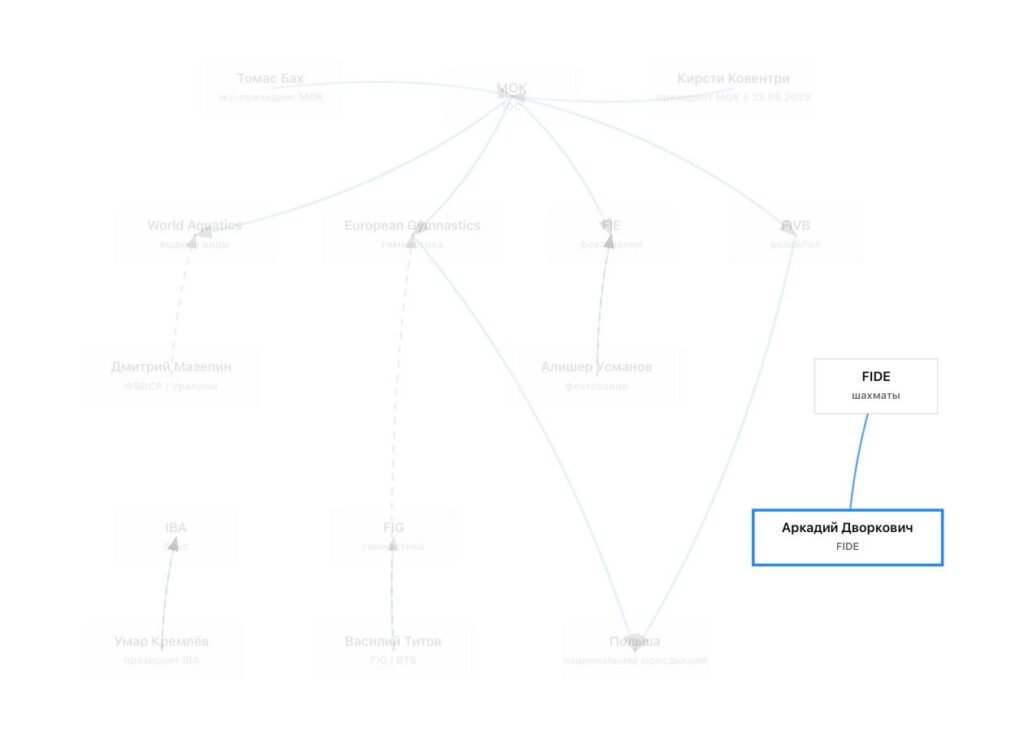
But the actual events of 2026 point in the opposite direction from claims that FIDE was “blocking CAS decisions.”
In March 2026, the Court of Arbitration for Sport ordered the Chess Federation of Russia to cease all activities in Russian-occupied territories of Ukraine within 90 days.
The order was not complied with.
On June 11, 2026, FIDE, under Dvorkovich’s leadership, suspended the Russian federation until at least the next General Assembly.
Moreover, on July 24, 2026, Dvorkovich temporarily stepped aside as FIDE president following EU sanctions. He called the decision unlawful and said he intended to challenge it.
His duties were transferred to deputy president and former world chess champion Viswanathan Anand.
Elections for a new leadership team are due to be held in Samarkand in September 2026.
The chess case therefore represents, on the evidence currently available, a rare example of an accountability mechanism functioning rather than being dismantled, as it is sometimes portrayed in commentary.
The point of resistance: where reintegration is running into obstacles
Perhaps the most revealing part of this story is not what international federations decide in Lausanne or Budapest, but what happens at the borders of individual EU member states.
The jurisdiction of sports organizations ends where national immigration and visa law begins.
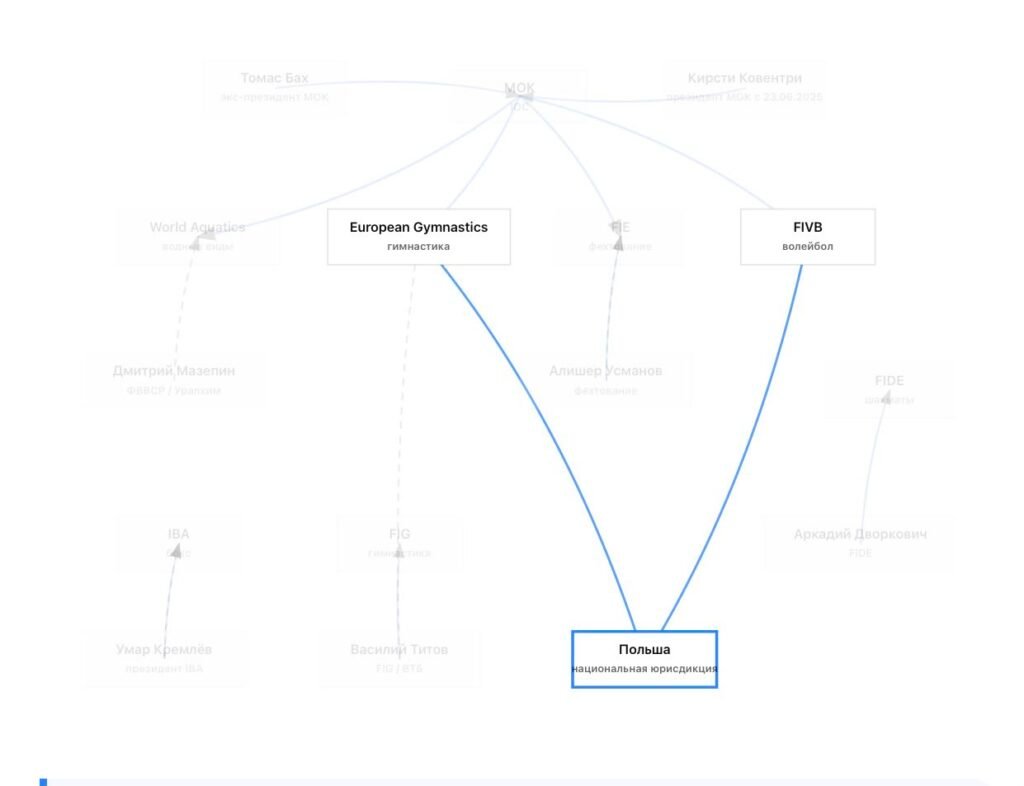
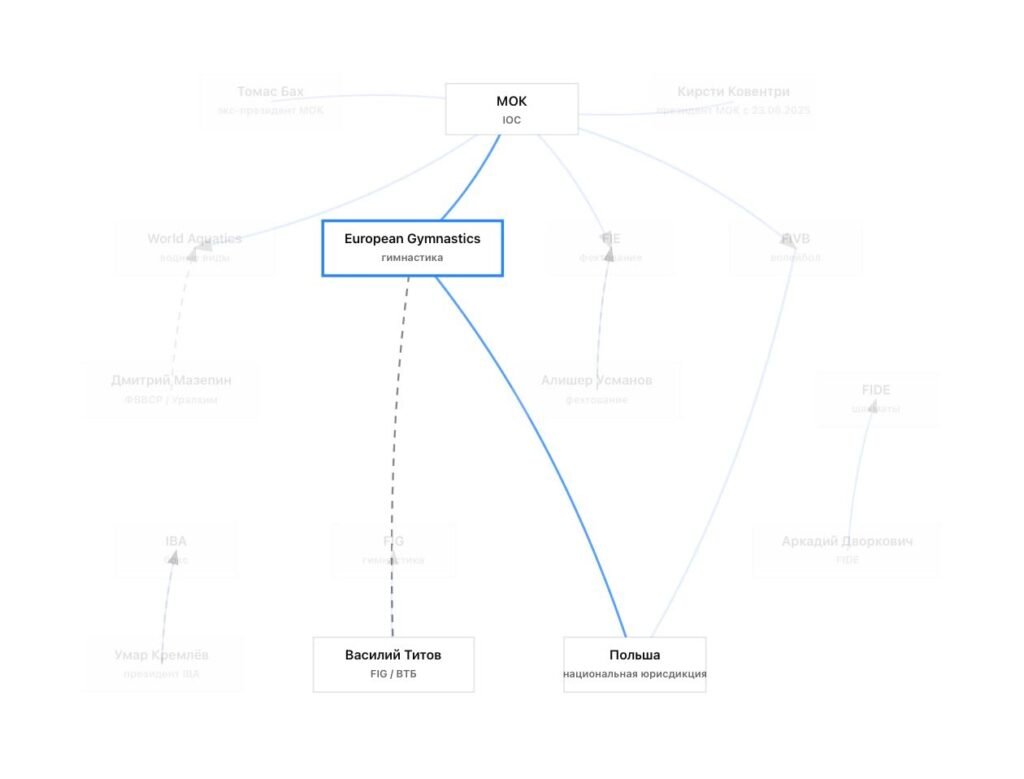
Poland has been the most consistent source of resistance.
Polish authorities denied visas to the Russian canoe slalom team ahead of the European Junior Championships in Kraków in June–July 2026.
Sebastian Świderski, president of the Polish Volleyball Federation, also said publicly that he was not prepared to take responsibility for the entry of Russian players for the 2027 World Championship hosted by Poland.
He referred to a 2014 incident in which a Russian volleyball player mimicked firing a weapon toward Ukrainian supporters.
As a result of the pressure, Russia’s national volleyball team itself withdrew from the 2027 men’s World Championship, citing the lack of security guarantees — despite the fact that the FIVB had formally cleared the way for its return.
Visa refusals have affected not only national teams but individual players as well.
For example, a Russian volleyball player at an Istanbul club was unable to obtain a visa to travel to Poland for a Champions League away fixture.
In practice, it is this layer — the national visa regimes of individual EU member states rather than decisions by international federations — that has become the last functioning filter capable of neutralizing the practical consequences of the “thaw” taking place at international level.

What is not confirmed — and what requires clarification
During the preparation of this investigation, no open-source confirmation could be found for some of the personal claims contained in an earlier version of the material.
These include, in particular, assertions about the “direct financing” of individual officials or descriptions of specific figures as the “architects of the dismantling of sanctions” beyond the documented roles outlined above.
Those claims appear to be interpretations rather than established facts.
They should either be supported by primary evidence — such as federation records, financial disclosures or CAS documents — or clearly framed as hypotheses rather than verified findings, particularly in an article that identifies individuals by name.
Conclusion
The picture that emerges in 2026 cannot be reduced to the claim that “the Kremlin bought the sports bureaucracy.”
The actual mechanism is more complex and multi-layered.
A shift in doctrine at the IOC has given individual federations greater freedom to act.
In some of them — including swimming and gymnastics — Russian business figures who have assumed leadership positions in national federations have made the return of Russian athletes an explicit priority and have pursued those interests through international sports structures.
In others — boxing and chess — similar efforts have either failed or encountered functioning accountability mechanisms.
And the only part of the system that, for now, continues to provide consistent resistance is the national visa regime of individual European Union countries — above all Poland — which can effectively neutralize decisions taken at federation headquarters.
This article was prepared using open-source material, including statements by the IOC, FIVB, FIE, World Aquatics, FIDE and IBA, as well as reporting by Suspilne Sport, RBC-Ukraine, Forbes.ru, Kommersant, Novaya Gazeta, 24 Kanal, Glavkom, Zaxid.net, Fontanka and other media outlets published between January and August 2026. Some formulations in the original source material were revised following fact-checking.