
How Russia Built the Conditions for the 2008 Invasion of Georgia
Georgia fired the opening barrage of the large-scale conflict on the night of 7-8 August 2008. But the war did not begin in a single night. Years of Russian passportisation, military patronage, infrastructure projects and escalating intervention had already transformed Georgia’s separatist territories into forward operating zones for Moscow.
Evidence base: EU Fact-Finding Mission, ECHR, ICC, NATO, UN, OSCE and Human Rights Watch
The night that became the whole story
At 11:35 p.m. on 7 August 2008, Georgian forces began an operation against Tskhinvali, the administrative centre of Georgia’s separatist region of South Ossetia.
Artillery fire struck the city and surrounding positions. Georgian troops advanced with the declared objective of restoring constitutional order and stopping attacks on Georgian-controlled villages.
Those events became the foundation of Russia’s official story. According to the Kremlin’s version, Georgia unexpectedly attacked South Ossetia, killing civilians and Russian peacekeepers. Moscow then intervened to prevent ‘genocide,’ protect Russian citizens and force Georgia to accept peace.
One part of that narrative is supported by international investigators: Georgia initiated the open, large-scale phase of the conflict.
But almost everything surrounding that fact is more complicated than the Kremlin’s version suggests.
The European Union’s Independent International Fact-Finding Mission concluded that the Georgian attack was not the beginning of the entire conflict. It was the culmination of a prolonged escalation involving armed provocations, Russian interference, military support for separatist forces and a gradual dismantling of Georgia’s sovereignty.
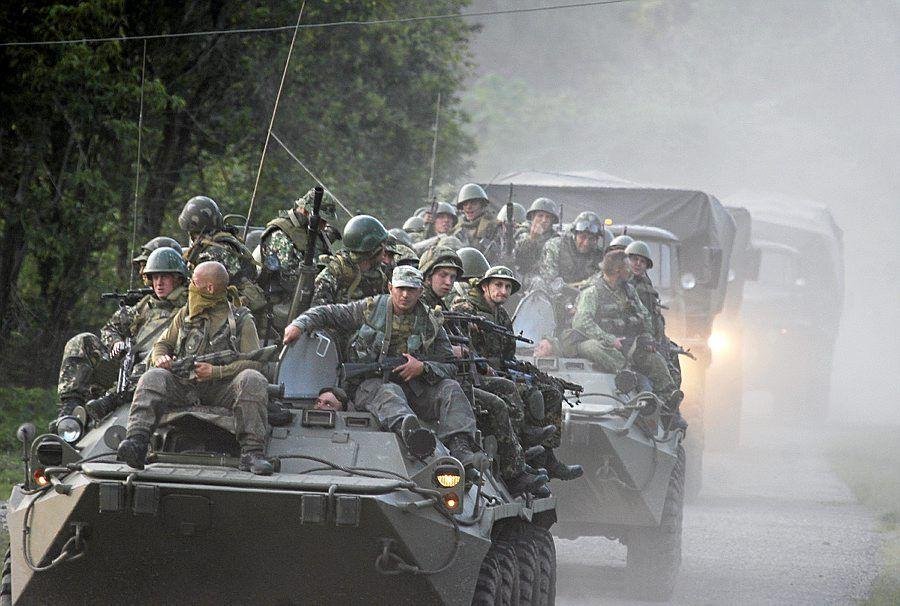
Russia’s subsequent campaign also went far beyond South Ossetia. Russian aircraft struck targets across Georgia. Armoured units entered Georgian cities and occupied strategic roads. Russian forces reached Gori, Senaki and Poti, while a second front opened in Abkhazia.
The evidence does not conclusively prove that a full-scale Russian invasion was already under way before Georgia opened fire. It does, however, show that Moscow had spent years creating the political, military and logistical conditions that made rapid intervention possible.
A conflict frozen in Russia’s favour
South Ossetia and Abkhazia emerged as separatist territories during the violent collapse of the Soviet Union. Both remained internationally recognised as parts of Georgia. Neither developed into an independent state in any meaningful sense. Their political survival depended heavily on Russian money, security guarantees, military support and access to Russian territory.
Russia was formally presented as a mediator and peacekeeper. In practice, it increasingly behaved as a patron of the separatist authorities. This dual role created an obvious conflict of interest: Moscow participated in negotiations over Georgia’s territorial integrity while simultaneously strengthening the forces that prevented Tbilisi from restoring control over its recognised territory.
The peacekeeping arrangements established in the 1990s gradually became obsolete. Instead of resolving the conflicts, they helped preserve a political and military reality favourable to Russia.
The EU-sponsored fact-finding mission described a broader clash between a Georgian government seeking closer integration with Western institutions and a Russian state determined to maintain a privileged sphere of influence in its so-called ‘near abroad.’ By 2008, Moscow had repeatedly demonstrated that it would not remain neutral if Georgia attempted to reassert control over South Ossetia or Abkhazia.
Russian passports as instruments of intervention
One of Moscow’s most consequential policies was the mass distribution of Russian citizenship in Georgia’s separatist regions.
Russia’s 2002 citizenship law simplified the naturalisation process. Thousands of South Ossetian and Abkhaz residents subsequently received Russian passports without the approval of the Georgian government.
By the eve of the war, Russia could claim that large parts of the population it had helped separate from Georgia were now composed of Russian citizens requiring Moscow’s protection.
The EU fact-finding mission concluded that this ‘passportisation’ policy challenged Georgian sovereignty and interfered in the country’s internal affairs. It also questioned whether many of those citizenship grants had to be recognised internationally.
- Russia supported the political separation of Georgian territories.
- Residents of those territories received Russian passports.
- Moscow then claimed a right to use force inside Georgia to defend its newly created citizens.
Russia did not merely respond to the existence of Russian nationals in South Ossetia. Its own policy had helped create that population. Passport distribution, political patronage and claims of protecting Russian citizens would later become recurring tools of Moscow’s influence in neighbouring states.
A security apparatus connected to Moscow
South Ossetia’s armed and security institutions were deeply connected to Russia. Senior officials included men with careers in Russian military or security structures. Mikhail Mindzaev, who served as South Ossetia’s de facto interior minister, was a former Russian official. Anatoly Barankevich, a former Russian military officer, served as secretary of the separatist Security Council.
These connections should be described carefully. Available evidence does not justify the sweeping claim that every South Ossetian institution was directly commanded by active-duty Russian officers.
The established facts nevertheless reveal something more significant than ordinary political sympathy: the separatist region’s security apparatus depended heavily on personnel, experience, supplies and institutional relationships originating in Russia. The EU mission also identified reports indicating that Russia had provided training and military equipment to South Ossetian and Abkhaz forces before the August conflict.
The Russian fighter identified by UN investigators
One of the clearest warning signs appeared months before the war. On 20 April 2008, a Georgian reconnaissance drone was shot down over Abkhazia. Video from the unmanned aircraft showed a military jet approaching immediately before the feed disappeared.
A United Nations Observer Mission in Georgia investigation concluded that the aircraft responsible belonged to the Russian military. The UN also found that Georgia’s drone flights violated the existing ceasefire arrangements. But the involvement of a Russian combat aircraft demonstrated that Moscow was not acting solely as a neutral peacekeeper.
Russia disputed the investigation. The incident was important not because it independently proved that Moscow had decided to invade Georgia. It showed that Russian forces were already prepared to use military power inside internationally recognised Georgian territory while publicly maintaining the language of mediation.
Railway troops arrive
At the end of May 2008, approximately 400 Russian railway troops entered Abkhazia. Their official task was to repair the railway between Sukhumi and Ochamchire. Moscow described the project as humanitarian and said the troops were unarmed.
But they had entered Georgian territory without Tbilisi’s consent and outside the established peacekeeping mission. On 3 June, NATO Secretary General Jaap de Hoop Scheffer stated that the deployment appeared to have no legal basis and contradicted Georgia’s sovereignty and territorial integrity.
The railway was completed shortly before the war. It subsequently provided useful infrastructure for Russian military movements on the Abkhaz front. The timing generated understandable suspicions: a railway suitable for moving heavy equipment had been restored by Russian military personnel only weeks before Russian and Abkhaz forces opened a second front.
The available documents do not conclusively establish that the repair mission was ordered as part of a finalised invasion plan. Presenting it as proven evidence of such a plan would go beyond what investigators established. But the deployment improved military logistics in a separatist territory, violated Georgian sovereignty and formed part of a wider pattern of Russian preparation and escalation.
Kavkaz 2008: readiness on the border
Between 15 July and 2 August, Russia conducted the Kavkaz 2008 military exercises in the North Caucasus. The manoeuvres involved thousands of personnel, including units from the 58th Army, aircraft, Interior Ministry forces and border guards. Activities took place close to Georgia and included scenarios connected to instability in South Ossetia and Abkhazia.
The exercise tested the reinforcement of Russian peacekeepers and the movement of forces in the Caucasus. Only days later, the 58th Army played a central role in the real intervention.
Georgia was also conducting military exercises. Immediate Response 2008 involved Georgian forces and troops from the United States, Armenia, Azerbaijan and Ukraine. The parallel Georgian-US exercise is essential context: military manoeuvres were not taking place on only one side.
Exercises alone do not prove intent to invade. Kavkaz 2008 nevertheless meant that Russian formations relevant to a Georgian contingency had recently mobilised, practised related missions and operated close to the area where war was about to begin. Some reports indicated that Russian units remained near the border after the exercises officially ended. South Ossetian authorities were meanwhile evacuating parts of the civilian population to Russia.
The days before the bombardment
Violence intensified during the first week of August. Explosions, sniper fire, mortar attacks and artillery exchanges affected Georgian and South Ossetian positions. Georgian-controlled villages came under fire. South Ossetian forces also reported Georgian attacks and casualties. Each side accused the other of deliberate provocation.
On 7 August, Georgian President Mikheil Saakashvili announced a unilateral ceasefire and called for negotiations. Fighting nevertheless continued, and Georgian authorities claimed that attacks on Georgian villages had intensified.
Later that night, Tbilisi made the decision that transformed the crisis into open war. At approximately 11:35 p.m., Georgian artillery began firing on targets in and around Tskhinvali. Georgian forces moved into South Ossetia.
The operation used heavy weapons in and near populated areas. It exposed civilians, peacekeepers and combatants to indiscriminate danger. Human Rights Watch subsequently documented indiscriminate and disproportionate attacks by Georgian forces. The EU mission concluded that Georgia’s use of force could not be legally justified by the explanations presented by Tbilisi.
Acknowledging Russia’s years of interference does not erase Georgia’s responsibility for launching a large-scale and legally unjustified assault. But acknowledging Georgia’s responsibility does not validate the rest of Moscow’s story.
Were Russian troops already inside?
Georgia later argued that its operation was intended partly to stop Russian units entering through the Roki Tunnel – the strategic road connecting Russia’s North Ossetia with South Ossetia. This remains the most contested element in the war’s chronology.
Georgian authorities cited intercepted communications and intelligence indicating that Russian troops and vehicles had begun moving before the Georgian bombardment. Russian media reports, soldiers’ accounts and other publications have also raised questions about Moscow’s official timeline. Some suggest that Russian personnel or equipment outside the authorised peacekeeping contingent were already present before Russia’s declared intervention time.
The EU mission examined these claims but did not find sufficient evidence to establish that a large-scale Russian invasion had begun before the Georgian operation.
| WHAT THE EVIDENCE SUPPORTS |
| Supported: unauthorised Russian presence, military assistance, volunteers or mercenaries and prior preparation.Not conclusively established: a full-scale Russian invasion before Georgia opened the large-scale attack. |
Preparation is not identical to invasion. Limited covert presence is not the same as a mass armoured advance. The uncertainties in the timeline should not be filled with political assumptions from either side.
Russia’s legitimate response – and the moment it became illegal
The EU commission divided Russia’s military actions into two phases. If Russian peacekeepers were attacked in Tskhinvali, Russia had the right to defend them with force proportionate to the threat. That limited right did not provide legal permission to invade the rest of Georgia.
Russian operations quickly expanded far beyond South Ossetia. Russian aircraft struck military and other targets across the country. Armoured forces crossed into undisputed Georgian territory. Russian troops entered or occupied areas around Gori, Senaki and Poti, controlled strategic highways and operated along the Black Sea coast.
In Abkhazia, Russian-supported forces attacked the upper Kodori Gorge, opening a second front unrelated to protecting peacekeepers in Tskhinvali.
The EU mission concluded that much of this expanded campaign went far beyond the reasonable limits of defence. It found that the scale and geographical reach of Russian military action were not remotely proportionate to the threat faced by Russian peacekeepers.
The legal situation had reversed. Georgia’s initial large-scale attack was unlawful. But once Russia expanded its operation deep into Georgia, Georgian forces had the right to defend the country against that wider intervention.
The genocide claim collapses
Russia’s emotional justification rested heavily on allegations of genocide. During the first days of the war, Russian officials claimed that approximately 2,000 South Ossetian civilians had been killed by Georgian forces.
Russian television repeatedly broadcast the figure. The allegation helped portray the intervention as an urgent humanitarian rescue rather than a military campaign against a neighbouring state.
The number did not survive scrutiny. Russian authorities later reduced the confirmed South Ossetian civilian death toll to 162.
Every civilian death was a tragedy. The Georgian use of heavy weapons in a populated area deserved investigation and condemnation. But the difference between 2,000 and 162 was not a minor statistical correction. The inflated figure had already served its political purpose during the decisive opening days of the war.
International investigators found no evidence of the specific intent required to prove genocide – the intention to destroy an ethnic, national, racial or religious group as such. The EU fact-finding mission concluded that the genocide allegations were unsupported in both fact and law.
The villages that disappeared
After Georgian forces withdrew, the violence did not end. South Ossetian forces and militias entered ethnic Georgian settlements. Homes were looted and burned. Civilians were assaulted, detained, expelled and, in some cases, killed.
Human Rights Watch described a deliberate and systematic campaign of destruction against certain Georgian villages. Its report, based on more than 460 interviews and extensive field research, documented grave violations by Georgian, Russian and South Ossetian forces.
The post-conflict destruction of Georgian settlements had a distinct purpose and pattern: removing Georgian residents and preventing their return. The EU mission found evidence of systematic looting and destruction, as well as forced displacement. It concluded that several elements indicated ethnic cleansing against Georgians in South Ossetia during and after the war.
Russian troops exercised control over much of the territory but repeatedly failed to stop the abuses.
What the European Court established
More than twelve years after the war, the European Court of Human Rights delivered its judgment in Georgia v. Russia (II). The Court distinguished the active fighting from the occupation period that followed the ceasefire of 12 August.
For the purposes of the European Convention on Human Rights, it did not find that the chaotic battlefield events between 8 and 12 August fell within Russia’s jurisdiction. This was a jurisdictional conclusion – not a ruling that Russian military conduct during those days was lawful.
For the subsequent period, the Court found that Russia exercised effective control over South Ossetia, Abkhazia and the ‘buffer zone’ occupied by Russian troops.
- killings of civilians;
- systematic burning and looting of Georgian homes;
- inhuman and degrading treatment;
- arbitrary detention of Georgian civilians;
- torture of Georgian prisoners of war;
- failure to conduct effective investigations;
- continuing obstruction of displaced Georgians seeking to return home.
The Court found that Russian forces were sometimes present while abuses occurred and that the measures taken to stop them were inadequate. Its judgment transformed part of the historical record into a binding legal determination: Russia exercised effective control and bore responsibility for violations committed during that period.
Arrest warrants from The Hague
The International Criminal Court investigated alleged crimes committed in and around South Ossetia between 1 July and 10 October 2008.
In 2022, the Court issued arrest warrants for three former senior South Ossetian officials: Mikhail Mindzaev, Gamlet Guchmazov and David Sanakoev. The allegations include unlawful confinement, torture, inhuman treatment, hostage-taking and the forcible transfer of ethnic Georgian civilians.
The ICC prosecutor described the alleged offences as part of a broader pattern that included the destruction and looting of Georgian villages and the denial of return to much of the Georgian population.
The warrants do not establish guilt; that requires trial. But they demonstrate that the crimes against Georgian civilians were not merely accusations exchanged in an information war. International investigators found sufficient evidence to seek the arrest of named suspects.
What the documents prove
- Georgia initiated the open, large-scale phase of the war by attacking Tskhinvali on the night of 7-8 August. The scale and character of that operation were not adequately justified under international law.
- Russia had spent years weakening Georgian sovereignty in the separatist territories through passportisation, political patronage, military assistance and deep institutional connections.
- Some Russian personnel outside the authorised peacekeeping contingent may have been present before Moscow’s officially declared intervention, but the EU mission did not conclusively establish a full-scale invasion before Georgia attacked.
- Russia had a limited right to defend its peacekeepers if they came under attack. Its subsequent advance across undisputed Georgian territory went far beyond that limited right.
- The Kremlin’s allegation of genocide was unsupported. The initial claim of approximately 2,000 civilian deaths was drastically reduced.
- Georgian, Russian and South Ossetian forces committed serious violations. After the Georgian withdrawal, South Ossetian formations conducted a systematic campaign against ethnic Georgian communities while Russian forces failed to prevent abuses in territories under their control.
The danger of choosing a convenient beginning
Propaganda often works by selecting the most useful starting point.
Begin the story late on 7 August and the narrative becomes simple: Georgia attacked. Russia responded.
Begin it several years earlier and a different sequence appears. Russia undermined Georgian sovereignty, created a population of passport-holding ‘citizens’ it could claim to protect, supported separatist security structures and increased its military readiness around the conflict zones.
Begin the story only with Russia’s advance and another distortion emerges – one that erases Georgia’s decision to use heavy force against Tskhinvali.
A credible investigation must resist both manipulations.
Georgia fired the opening barrage of the large-scale war. Russia built much of the environment in which that decision was made and then used the conflict to launch a campaign extending far beyond South Ossetia.
The distinction between ‘who fired first’ and ‘who created the conditions for war’ is not an exercise in semantics. It is the difference between a single night’s chronology and the anatomy of a state strategy.
In August 2008, the first shot was not the whole beginning. It was the final trigger in a confrontation that had been politically engineered, militarily prepared and progressively escalated over years.
Methodology and editorial standards
This investigation distinguishes between established findings, credible reports and unresolved allegations. It does not treat evidence of Russian preparation as automatic proof that a full-scale invasion began before Georgia’s attack, and it does not treat Georgia’s initiation of large-scale hostilities as legal justification for Russia’s subsequent advance deep into undisputed Georgian territory.
Primary documents and source notes
The following sources provide the documentary foundation for this investigation. Volume I of the EU mission contains the commission’s principal findings. Volume II provides detailed historical, military and legal analysis. Volume III largely reproduces submissions and documents supplied by the parties and should not be treated as the commission’s independent conclusions.