
The escalation of hostilities across the Azov–Black Sea region in the summer of 2026 sharply reduced the volume of Russian cargo moving through Black Sea ports.
At the same time, it increased the strategic importance of Turkey, which controls the Bosporus and the Dardanelles — the maritime gateway linking the Black Sea with the Mediterranean.
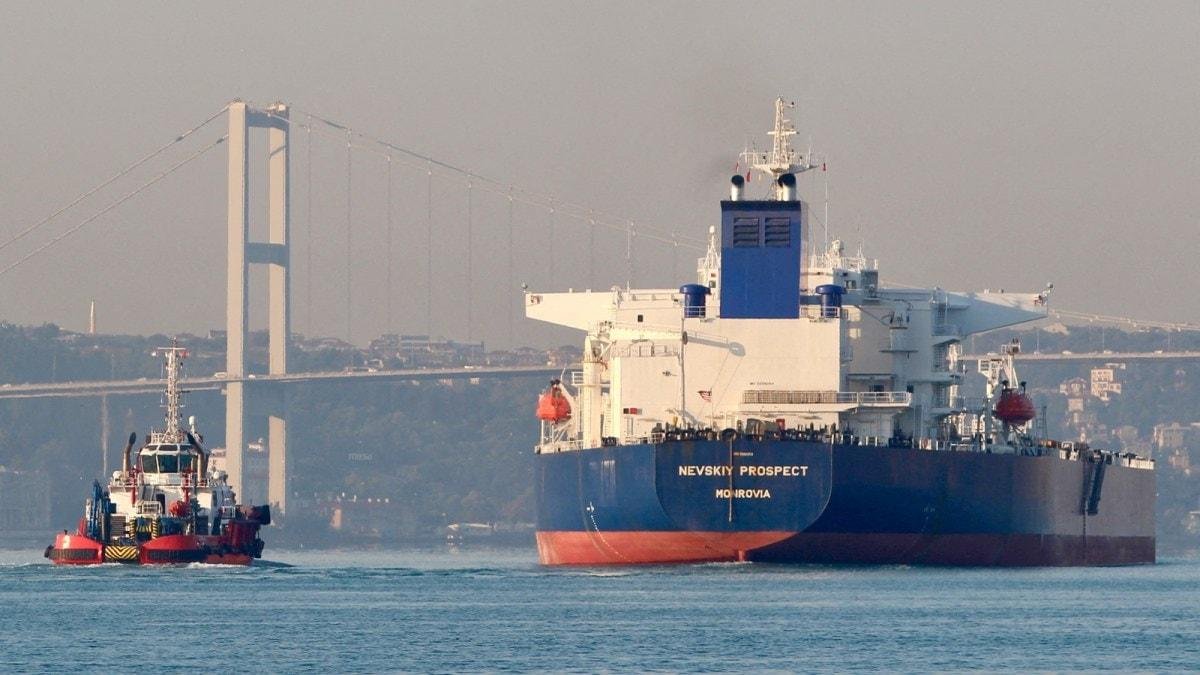
An investigation by the Association of Reintegration of Crimea argues that vessels associated with Russia’s so-called shadow fleet continue to cross the Turkish Straits through a system of mandatory charges and additional maritime services provided by Turkish state bodies and private operators.
The arrangement exposes a broader weakness in the sanctions regime.
A tanker may already be listed under US, EU or Swiss sanctions, yet it can still require — and obtain — pilotage, tugboat assistance, insurance documentation, banking services and access to port infrastructure in order to continue operating.
The passage of a sanctioned vessel through an international strait does not by itself establish a sanctions violation. But the financial and service chain surrounding that passage raises questions about who is being paid, how transactions are settled and what level of due diligence is applied to vessels with opaque ownership and insurance arrangements.
Freedom of passage — but not free passage
The legal framework governing the Bosporus and the Dardanelles remains the 1936 Montreux Convention.
It guarantees freedom of passage for merchant vessels while allowing Turkey to collect three categories of charges: sanitary inspection fees, lighthouse dues and fees connected to rescue services. The amount depends on a ship’s tonnage.
Pilotage and tugboat assistance are formally voluntary under the Convention.
In practice, however, later Turkish regulations have made those services increasingly important — and for some classes of vessel, effectively difficult to avoid.
Turkey introduced tighter rules for tankers in 1994. Procedures governing traffic through the straits can give practical priority to ships using pilots, while vessels declining pilotage may face substantially longer waits.
Since 2018, tankers and gas carriers longer than 150 metres have been required to transit during daylight hours and with tugboat assistance. Vessels exceeding 300 metres must provide advance notice at least ten days before passage.
The rules are intended to reduce the risk of collisions, oil spills and other disasters in one of the world’s busiest and most difficult waterways.
But they have also transformed services described as voluntary under the Convention into an operational necessity for many large vessels.
Straits charges have risen sharply
The dues permitted under the Montreux Convention were originally linked to the gold franc, an accounting unit that has long since fallen out of practical use.
Turkey therefore applies a dollar-denominated equivalent determined by its authorities.
For decades, the rate remained at roughly $0.80 per notional gold franc.
That changed dramatically on October 7, 2022, when Turkey increased the conversion rate to $4.08.
According to figures cited in the investigation, the move was expected to raise annual income from the relevant charges from approximately $40 million to as much as $200 million.
The volume of maritime traffic makes the sums significant.
In 2022, 35,146 vessels passed through the Bosporus, while 42,340 transited the Dardanelles.
Further increases followed.
The conversion rate rose to $4.42 in July 2023, $5.83 in July 2025 and $6.70 in July 2026.
For a vessel of around 10,000 tons, the relevant charge rose from roughly $3,200 before 2022 to about $16,300 in autumn 2022 and approximately $17,700 by summer 2023.
Experts cited in the investigation estimate that Russia’s war against Ukraine and the heightened risks surrounding Black Sea shipping now generate more than $100 million a year for Turkey through revised mandatory charges.
Pilotage and tugboats add another layer of cost
Convention-authorised dues represent only part of the expense.
Shipowners can pay substantially more for pilotage and tugboat assistance.
According to tariff figures cited in the investigation, basic pilotage through the Bosporus costs about $600 for a vessel of up to 1,000 tons, with another $107 for each additional 1,000 tons.
For a 50,000-ton vessel, the base charge exceeds $5,500.
Tankers are then subject to an additional multiplier of 1.3. Weekend and public-holiday transits carry a further multiplier of 1.5.
The standard tariff covers three hours. Longer passages generate additional charges, while pilotage through the Dardanelles is billed separately.
Pilotage in the Turkish Straits remains a state monopoly.
Tugboat services are provided both by state-owned entities and selected private Turkish operators.
The investigation says tugboat hire can cost from $6,000 per hour, with additional operational charges ranging from approximately $1,400 to $3,600.
The result is a predictable revenue stream.
Every passage by a large tanker can generate payments to Turkish state institutions through official dues and pilotage fees, while tugboat services may generate additional income for either public or private operators.
Where the sanctions gap appears
The most sensitive question concerns services provided to vessels already listed under sanctions imposed by the United States, European Union or Switzerland.
Turkey can point to the international principle of freedom of passage for merchant shipping.
But pilotage and tugboat services occupy a more complicated position.
They are not defined as mandatory under the Montreux Convention itself, and their commercial tariffs are established by Turkish entities.
Before obtaining those services, shipowners must provide detailed vessel information, including proof of liability coverage through a recognised protection and indemnity, or P&I, insurer.
That requirement exposes another weakness.
Major international marine insurers generally comply with Western sanctions regimes.
Much of Russia’s shadow fleet therefore relies on insurance arrangements that may be opaque, incomplete or financially unreliable.
Despite those concerns, vessels associated with the shadow fleet continue to transit the Bosporus and Dardanelles while obtaining the operational support required for passage.
Preferential rules may create additional commercial relationships.
Priority can be granted to tankers carrying cargo to Turkish refineries, vessels bound for energy installations and ships travelling to Turkish yards for maintenance or repair.
None of this automatically proves a sanctions breach.
But it does create a case for examining the full service chain around sanctioned vessels, including:
- the ultimate recipients of payments;
- participating banks and intermediaries;
- currencies and settlement mechanisms;
- the authenticity and adequacy of insurance documents;
- the legal basis for providing additional commercial services to sanctioned vessels or companies.
Russia’s separate revenue system in the Kerch Strait
The investigation also examines a different system operating in the Kerch Strait and the Kerch–Yenikale Canal.
Before Russia’s occupation of Crimea, passage fees were legally collected by Ukrainian maritime authorities based in Kerch.
After 2014, that revenue stream was taken over by entities controlled by Russia.
Occupation authorities initially introduced dollar-denominated tariffs calculated for every 1,000 cubic metres of vessel volume.
The charges included:
- $8.70 for lighthouse services;
- $45.50 for pilotage;
- $253 in canal dues.
In 2015, Russian authorities declared pilotage compulsory for almost all foreign vessels, with exemptions limited largely to small, shallow-draft ships permanently operating in the strait.
In some years, as many as 22,000 vessels passed through the Kerch Strait.
The Association estimates that the resulting system generated tens of millions of dollars for Russian-controlled structures.
By 2020, their combined annual revenues had reached at least one billion roubles, with Kerch Strait passage fees accounting for a substantial portion.
That year, collection responsibilities were transferred to a Russian state port authority and a new tariff structure was introduced.
Alongside vessel, canal, lighthouse, navigation and pilotage dues, authorities imposed a separate one-off payment of 20,820 roubles for guiding a vessel through the Kerch–Yenikale Canal.
Calculations cited in the investigation suggest that this single charge may have generated at least 400 million roubles in 2021.
Revenue without transparency
The collection of substantial passage fees did not necessarily produce a corresponding improvement in maritime safety.
Major incidents in the area have raised questions over the technical condition of vessels, the coordination of pilotage services, personnel training and the reliability of insurance coverage.
The investigation argues that Russian-controlled entities collect multiple categories of charges while providing little public transparency about how the resulting revenue is used.
The risks are particularly acute for ageing tankers operating with unclear ownership structures, questionable documentation or insurance of uncertain financial value.
If one of those ships causes a major oil spill or maritime disaster, insurance coverage may prove inadequate to compensate for environmental and economic losses.
The infrastructure behind the shadow fleet
The investigation ultimately identifies two different financial systems.
The first operates through the Bosporus and the Dardanelles.
Russia’s shadow fleet pays official passage charges while also purchasing services that many large tankers can scarcely avoid. Payments flow to Turkish state institutions and private maritime operators.
The second operates in occupied Crimea, where Russia has appropriated Ukrainian regulatory functions and converted passage through the Kerch Strait into a source of revenue for Russian-controlled structures.
The broader sanctions question therefore extends well beyond the ships themselves.
A shadow-fleet tanker can change its name.
It can change its flag.
It can move ownership through offshore companies and register in another jurisdiction.
But it cannot operate without access to waterways, ports, banking channels, insurance, repairs, pilots and navigational assistance.
The investigation identifies those dependencies as critical pressure points for European and other sanctions authorities.
Regulators examining the shadow fleet may therefore need to look not only at vessels and their nominal owners, but also at the surrounding infrastructure:
banks, payment intermediaries, insurers, pilots, tugboat operators, repair yards, ship agents and the entities collecting maritime dues.
Without scrutiny of that supporting network, sanctions aimed at Russia’s shadow fleet risk remaining only partially effective.
The investigation argues that the supporting services and financial infrastructure may offer regulators more effective points of scrutiny than vessel ownership alone.