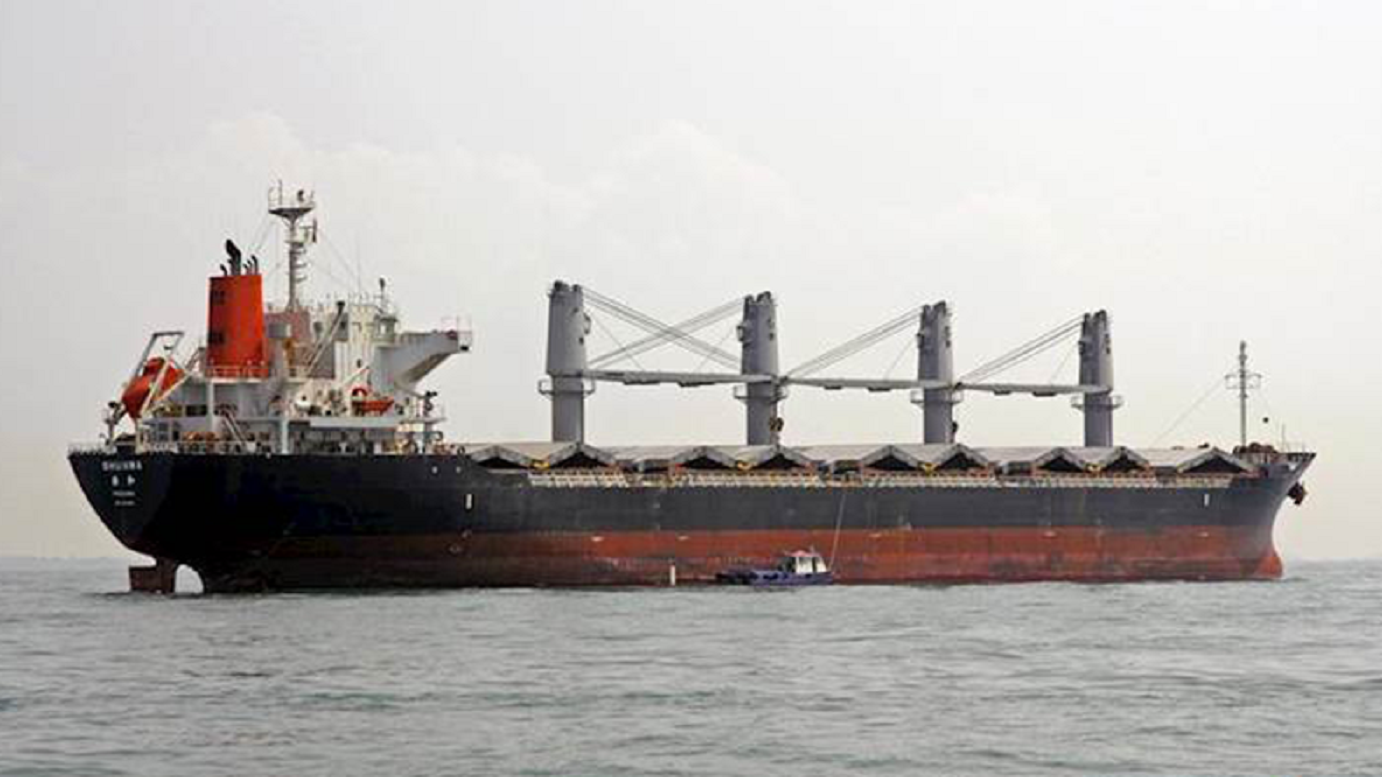

A Russian-flagged bulk carrier, the Grumant, delivered grain loaded at the occupied Ukrainian port of Feodosia to Benghazi, Libya, in April 2026, according to an investigation published on June 12. The case marks only the second documented instance of a Russian vessel delivering what Ukrainian authorities describe as stolen grain to Libya, and it introduces a new method for tracking ships through waters where GPS signals are routinely jammed.
Researchers identified the Grumant (IMO 9385879) at berth No. 1 in Feodosia on February 15, 2026, through high-resolution satellite imagery matching the ship’s grey deck, seven cargo hatches, and distinctive yellow foremast. The vessel then sailed for two months — transiting the Bosphorus, anchoring for weeks off Izmir and Aliağa in Turkey without explanation, and finally docking at Benghazi on April 18, where it unloaded its cargo before returning toward the Black Sea.
Method: reading a ship’s compass instead of its GPS
The investigation’s central methodological contribution addresses a known problem in the region: satellite positioning data for ships transiting the Black Sea is frequently unreliable because of GNSS interference, standard in that area since Russia’s invasion of Ukraine. The approach, built on heading data supplied by Lloyd’s List Intelligence, worked around this by focusing on a different data point broadcast by the same Automatic Identification System (AIS) — the ship’s compass heading — which, unlike GPS position, is generated onboard and is not affected by the same jamming.
Between February 7 and 19, 2026, the Grumant transmitted 29 AIS messages consistently reporting a heading of 267–268 degrees — matching the Port of Feodosia’s own heading of 267.5 degrees almost exactly, while its reported GPS position during the same window was erratic and, at points, placed the ship on land. Satellite imagery cross-checked against this data showed a vessel present at the berth on matching dates, and no other ship transmitting AIS in the area reported a heading matching the port over that period.
A former U.S. Navy officer and maritime-sanctions specialist consulted for the report, Charlie Brown, said the technique made sense as a way to extract usable signal from otherwise compromised data, though he cautioned that heading data should still be cross-referenced against other sources rather than relied on alone.
Gaps in the trail
Ships making calls to occupied Ukrainian ports frequently disable their AIS transponders entirely during so-called “dark port calls” — a known tactic in sanctioned trade — and the Grumant did go dark for several days in early February, though it kept transmitting intermittently through most of its stay in Feodosia; why it did so during this particular voyage, when it has operated fully dark for as long as 59 days on prior trips, was not established.
Ownership and corporate trail
According to Russian court filings cited in the report, the Grumant’s previous owner, Murmansk Shipping Company, has been dissolved, and a company called “Decision/Reshenie” LLC is listed in official filings as the vessel’s international safety manager and operator. The company was contacted for comment on the shipment but had not responded by the time of publication.
Positions of the parties
Ukraine’s Ministry for Development of Communities and Territories and its Ministry of Foreign Affairs said jointly that commercial activity at Feodosia is illegal under Ukrainian law since the port lies in occupied Crimea, and that Russia is using such ports to monetize stolen agricultural products while expanding illicit export routes to third countries, including in North Africa. Ukraine’s foreign ministry said it forwarded information about the Grumant’s alleged activities to diplomatic missions in the UK, Turkey, and Tunisia between March and May 2026.
Comment was also sought from Libya’s rival administrations — the Tripoli-based Government of National Unity and the Benghazi-based Libyan National Army that controls the port where the Grumant unloaded — as well as from the ports of Benghazi and Izmir. None responded before publication. Libya’s embassy in the Netherlands replied afterward, stating that Benghazi and eastern Libya fall outside the Government of National Unity’s administrative control and that it was therefore not positioned to comment on the findings.
Context: a wider smuggling pattern
A political scientist specializing in Libya at the Royal United Services Institute, Jalel Harchaoui, said Libya’s two rival governments are not currently at war but observe an uneasy truce, and that opaque ports such as Misrata have previously handled Russia-linked shipments even under a nominally pro-Ukraine administration, when the right payments are made. It remains unknown from open sources alone whether authorities in Benghazi were aware the Grumant’s cargo originated in occupied Ukraine.
This case fits a pattern tracked over time: five previously identified vessels in this smuggling network have since been sanctioned by the EU, and another by the U.S. Treasury. Separately, Ukrainian authorities say a Swedish court recently approved transferring a different vessel from this “shadow grain fleet,” the Caffa, to Ukraine for investigation after its detention in Swedish waters — a step Kyiv describes as a new precedent going beyond sanctions toward the physical seizure of such ships in European jurisdictions.