
Billions in oil revenue, off-budget road contracts and a narrow circle around the presidency coexisted with salary arrears, extreme inflation and mass hunger. The record establishes a system of political responsibility even where personal criminal liability has not been proved.
How does a country earn tens of billions of dollars from oil while most of its citizens remain poor and more than half the population faces acute food insecurity?
That is the central contradiction of South Sudan under President Salva Kiir. Since independence, oil has supplied the overwhelming majority of government export income. Yet the state has repeatedly failed to convert that income into dependable roads, salaries, hospitals, schools or protection from hunger.
Evidence base: United Nations commission reports, World Bank public-finance data, World Food Programme and partner-agency assessments, United States sanctions records, government responses, procurement documents reviewed by OCCRP, and public budget material reviewed by Project Truth International.
The contradiction in five figures
| Figure | What the record says |
|---|---|
| About $24.5 billion | Oil-export revenue generated from independence through the end of 2025, according to the UN Commission [1]. |
| More than $3 billion | Unrepaid oil-backed foreign loans reported by the same Commission [1]. |
| About $2.2 billion | Estimated disbursements through the off-budget Oil for Roads programme from 2021 to 2024 [2]. |
| 87 percent | Estimated share of the population living in extreme poverty in 2025, according to the World Bank [4]. |
| 7.8 million | People projected to face crisis-level hunger or worse between April and July 2026 [5]. |
Oil wealth that did not become public wealth
The scale of South Sudan’s oil income makes the country’s poverty more than a humanitarian tragedy. It makes it a public-finance question.
The UN Commission on Human Rights in South Sudan reported in March 2026 that the government had generated approximately $24.5 billion from oil exports between independence and the end of 2025. It also cited more than $3 billion in unrepaid oil-backed foreign loans. These figures do not mean that the full amount was freely available for domestic spending: production costs, payments to Sudan, debt service, pipeline disruptions and war all reduced usable revenue. But they establish the scale of resources that passed through a state whose citizens continued to receive exceptionally weak public services [1].
The World Bank’s 2026 Public Finance Review reached a parallel conclusion from fiscal data. South Sudan entered independence with control of roughly 70 percent of the former Sudan’s commercial oil reserves and a revenue position stronger than many comparable states. By 2024, total economic output had fallen by more than half from 2011, while output per person had contracted by 76 percent [3].
The World Bank attributes the collapse to a combination of civil conflict, pipeline disruption, extreme oil dependence, chronic underinvestment and governance failures. That qualification matters. Corruption is not the only cause of South Sudan’s economic crisis. But opaque revenue management and distorted spending made the country less able to survive every other shock.
The Oil for Roads system
The clearest test case is the Oil for Roads programme, a mechanism under which crude-oil revenue was committed directly to infrastructure rather than passing transparently through ordinary budget controls.
In a September 2025 investigation, the UN Commission calculated that approximately $2.2 billion had been disbursed from 2021 to 2024 to companies it identified as affiliated with businessman Benjamin Bol Mel. The Commission compared those payments with the value and condition of the roads delivered. Its calculation left roughly $1.7 billion unsupported by corresponding completed infrastructure. It reported that only a small fraction of the road network required under the contracts had been completed [2].
These are findings by an international investigative commission, not a criminal judgment by a court. South Sudan’s government rejected the report, disputed the sums and accused the Commission of methodological errors. Justice Minister Joseph Geng said the figures were implausibly high in light of the country’s economic realities. Government representatives also described the report as an attempt to damage the country’s leadership [11].
The response challenges the Commission’s calculations, but it does not answer the underlying transparency problem. The contracts, oil allocations, payment schedules, beneficial ownership records, engineering certificates and independently verified kilometres of completed road have not been published together in a form that allows the public to reconcile money paid with infrastructure delivered.
The unresolved issue is therefore larger than one disputed figure. A government that rejects an external calculation can rebut it decisively by releasing the complete underlying accounts.
The businessman who entered the presidency
Benjamin Bol Mel illustrates how commercial influence and political authority became difficult to separate.
The United States placed Bol Mel under Global Magnitsky sanctions in 2017. The Treasury Department alleged that a construction company he oversaw had received preferential treatment from senior South Sudanese officials and obtained roadwork without a competitive process [6]. In 2021, the Treasury sanctioned ARC Resources Corporation and Winners Construction Company, describing them as controlled by Bol Mel and stating that they had received substantial non-competitive oil-backed road contracts. Treasury also alleged that the companies had been used to evade restrictions associated with his designation [7].
Sanctions are executive measures, not criminal convictions. Bol Mel and South Sudanese authorities have disputed allegations surrounding the road programme. Those distinctions must remain explicit.
The political sequence is nevertheless significant. President Kiir appointed Bol Mel as a vice-president responsible for the economic cluster on 10 February 2025. Kiir dismissed him on 12 November 2025, weeks after the UN Commission published its Oil for Roads findings. The Commission’s March 2026 report described the episode as part of a broader concentration of political and economic power around the presidency [1].
An appointment does not prove participation in corruption. It does show that a businessman already sanctioned by the United States and linked by investigators to major state contracts was elevated into one of the country’s highest offices. In a system with weak procurement disclosure and limited parliamentary scrutiny, that movement between contractor networks and executive power is itself a matter of public interest.
A wider pattern of connected contracts
Oil for Roads was not the first case in which large contracts appeared to cluster around businessmen with access to the presidency.
An OCCRP investigation based on contracts, bank records and government correspondence found that between 2016 and 2018 the government awarded approximately $1.4 billion in contracts for food and vehicles to four companies traceable to three businessmen with close ties to the Office of the President [9]. Two of those businessmen, Ashraf Seed Ahmed Al-Cardinal and Kur Ajing Ater, were sanctioned by the United States in 2019 over alleged bribery, kickbacks and procurement fraud involving senior officials [8].
Again, administrative sanctions and investigative findings are not substitutes for criminal convictions. Nor does the evidence establish that President Kiir personally directed every contract. What the records reveal is recurrence: large public transactions, a small number of connected commercial actors, weak competition and limited public accounting.
When the same institutional weaknesses appear across different years, companies and spending programmes, the explanation becomes harder to reduce to isolated misconduct by individual officials.
Presidential spending and an unpaid state
The consequences are visible in the national accounts.
The World Bank reports that South Sudan’s fiscal deficit widened to 6.7 percent of gross domestic product in the 2025 financial year, driven primarily by increased spending from the Ministry of Presidential Affairs. By January 2026, civil servants were carrying salary arrears of eight to thirteen months. Average food inflation reached 234 percent during the financial year, while the official exchange rate depreciated by 198 percent and the parallel rate by 224 percent [4].
The Dar Blend pipeline shutdown was a major cause of the revenue shock. But the same World Bank assessment says significant off-budget expenditure obscured a larger deficit and added to price pressures. Its Public Finance Review found that government spending remained skewed toward administration, security and rule-of-law institutions while health, education and social protection were severely underfunded [3].
A state reveals its priorities not only through speeches, but through which institutions continue spending and which workers remain unpaid. When the office surrounding the president expands expenditure while teachers, health workers and other civil servants wait months for salaries, fiscal failure becomes a question of political hierarchy.
Power concentrated around one office
Financial opacity has developed alongside political concentration.
The UN Commission reported that the Council of Ministers and Transitional National Legislative Assembly did not convene for most of 2025, while senior officials were repeatedly rotated without public explanation. It said executive authority became more concentrated around President Kiir [1].
On 20 August 2025, Kiir appointed his daughter, Adut Salva Kiir, as Senior Presidential Envoy for Special Programmes. The appointment is a documented fact. It is not evidence that she controls oil revenue, minerals, airport fees or other state income, and Project Truth International found no reliable public record establishing those broader claims. Publishing them as fact would go beyond the evidence.
The appointment is still relevant because it places a presidential family member in a senior role inside a system already criticised for concentrated decision-making and insufficient oversight. The public-interest question is not her surname alone. It is the authority attached to the position, the programmes under its control, the budget it can influence and the disclosure rules that apply.
The human cost of fiscal failure
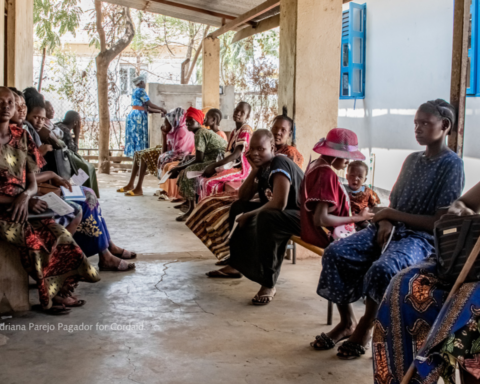
In April 2026, the World Food Programme, the Food and Agriculture Organization and UNICEF warned that 7.8 million people – 56 percent of South Sudan’s population – were expected to face crisis-level hunger or worse during the lean season. They estimated that 73,300 people would face catastrophic conditions and that 2.2 million young children were suffering acute malnutrition [5].
The agencies identified conflict, displacement, economic decline, flooding, weak agricultural production, damaged health facilities and restricted humanitarian access as immediate drivers. It would be inaccurate to attribute every hungry household directly to a corrupt transaction.
But the connection between governance and vulnerability is not speculative. Money diverted from services, roads or salaries weakens the systems that should protect citizens when war, floods or market shocks arrive. Corruption becomes a human-rights issue when it determines whether a clinic has supplies, a road can carry aid or a family can afford food.
What the government says
South Sudanese officials have rejected the UN Commission’s central corruption allegations. They described parts of its Oil for Roads analysis as absurd, methodologically flawed and outside the Commission’s proper mandate. The government said the report relied on unverified information and unfairly damaged the country’s image [11].
The government has also publicly committed to reform. In response to the World Bank’s 2026 Public Finance Review, a senior Ministry of Finance official said the authorities intended to strengthen budget discipline and accelerate public-finance reforms. The World Bank recommended that all oil revenues be transferred into the National Revenue Fund, quarterly oil data be published, salary payments be prioritised, capital projects be disclosed and new non-concessional oil-backed borrowing be avoided [3].
Those commitments create a measurable test. Reform can be assessed through published contracts, audited accounts, regular budget-execution reports and independently verified infrastructure – not through assurances alone.
What the evidence establishes
-
South Sudan generated very large oil revenues while poverty, wage arrears and underfunded services deepened.
-
The Oil for Roads programme moved substantial oil-backed resources outside ordinary budget processes, and the value of completed infrastructure has been seriously disputed.
-
Companies and businessmen with connections to the presidency repeatedly received major government contracts, while several were later subjected to United States corruption-related sanctions.
-
The Ministry of Presidential Affairs became a major driver of fiscal pressure in the 2025 financial year as other parts of the state accumulated salary arrears.
-
Executive power and key appointments became increasingly concentrated around President Kiir during 2025.
What the evidence does not establish
-
It does not prove that President Kiir personally received the money identified in the Oil for Roads investigation.
-
It does not establish that every Oil for Roads payment was unlawful or that every contractor failed to perform work.
-
It does not convert United States sanctions designations into criminal convictions.
-
It does not support claims that Adut Salva Kiir personally controls all oil and non-oil revenue, minerals or airport fees.
-
It does not mean corruption alone caused South Sudan’s crisis; conflict, pipeline disruption, climate shocks and regional instability were also major drivers.
Responsibility at the top
Criminal responsibility requires evidence tied to specific acts and individuals. Political responsibility is broader.
Salva Kiir has led South Sudan throughout its independence. The presidency has controlled senior appointments, exercised decisive influence over oil policy and overseen spending systems repeatedly criticised for opacity, off-budget transactions and weak scrutiny. Even without evidence that Kiir personally benefited from each disputed payment, he cannot be separated from the architecture through which those payments were authorised and protected from effective oversight.
The pattern documented across UN reports, World Bank assessments, sanctions records and procurement investigations is not simply that South Sudan experienced corruption while Kiir happened to be president. It is that political power, commercial access and control over state resources repeatedly converged around the presidency during his rule.
The result is a country with oil wealth but an unpaid public service; road contracts but missing roads; a large security and administrative state but weak hospitals and schools; and a political elite governing a population in which hunger and extreme poverty have become normalised.
The records that could settle the dispute
The government can challenge the central findings through disclosure. At minimum, the following records should be made public in searchable form:
-
all crude-oil sales, prepayment agreements and oil-backed loan schedules since independence
-
the complete Oil for Roads contract register, including beneficial owners and subcontractors
-
bank-level payment records matched to each certified section of completed road
-
independent engineering inspections with geolocated evidence of work delivered
-
quarterly budget-execution reports for the presidency, security sector and service ministries
-
audited financial statements for the central bank, oil institutions and major infrastructure programmes
-
asset and conflict-of-interest declarations for senior officials responsible for procurement and resource policy
If the UN calculations are wrong, these records would provide the strongest rebuttal. If they are withheld, the central problem remains: the public is being asked to trust a system that does not permit the public to verify it.
Methodology and source note
This investigation was compiled from open-source material. Project Truth International compared figures across UN Commission reports, World Bank fiscal analysis, humanitarian assessments, United States sanctions notices and investigative reporting based on contracts and bank records. Claims by official bodies are attributed to those bodies. Sanctions are described as administrative designations rather than convictions. Government denials and reform commitments are included.
The article distinguishes between documented appointments, financial estimates, allegations, analytical conclusions and facts that the available record does not establish. Figures can differ across institutions because they use different definitions, reporting periods and data limitations. The World Bank itself warns that South Sudan’s public-finance data are incomplete and sometimes inconsistent [3].
Sources
2. UN Commission on Human Rights in South Sudan – Plundering a Nation A HRC 60 CRP 5, September 2025
3. World Bank – South Sudan Public Finance Review, 2026
4. World Bank – South Sudan country economic update
5. WFP FAO and UNICEF – Hunger intensifies in South Sudan, 28 April 2026
6. US Treasury – Global Magnitsky designation concerning Benjamin Bol Mel, 21 December 2017
7. US Treasury – Sanctions on ARC Resources and Winners Construction, 9 December 2021
8. US Treasury – Sanctions on Ashraf Seed Ahmed Al-Cardinal and Kur Ajing Ater, 11 October 2019
9. OCCRP – As South Sudan Seeks Funds for Peace a Billion Dollar Spending Spree
10. Transparency International – South Sudan country profile and CPI 2025
11. Reuters – UN report details systematic looting by South Sudan rulers, 16 September 2025