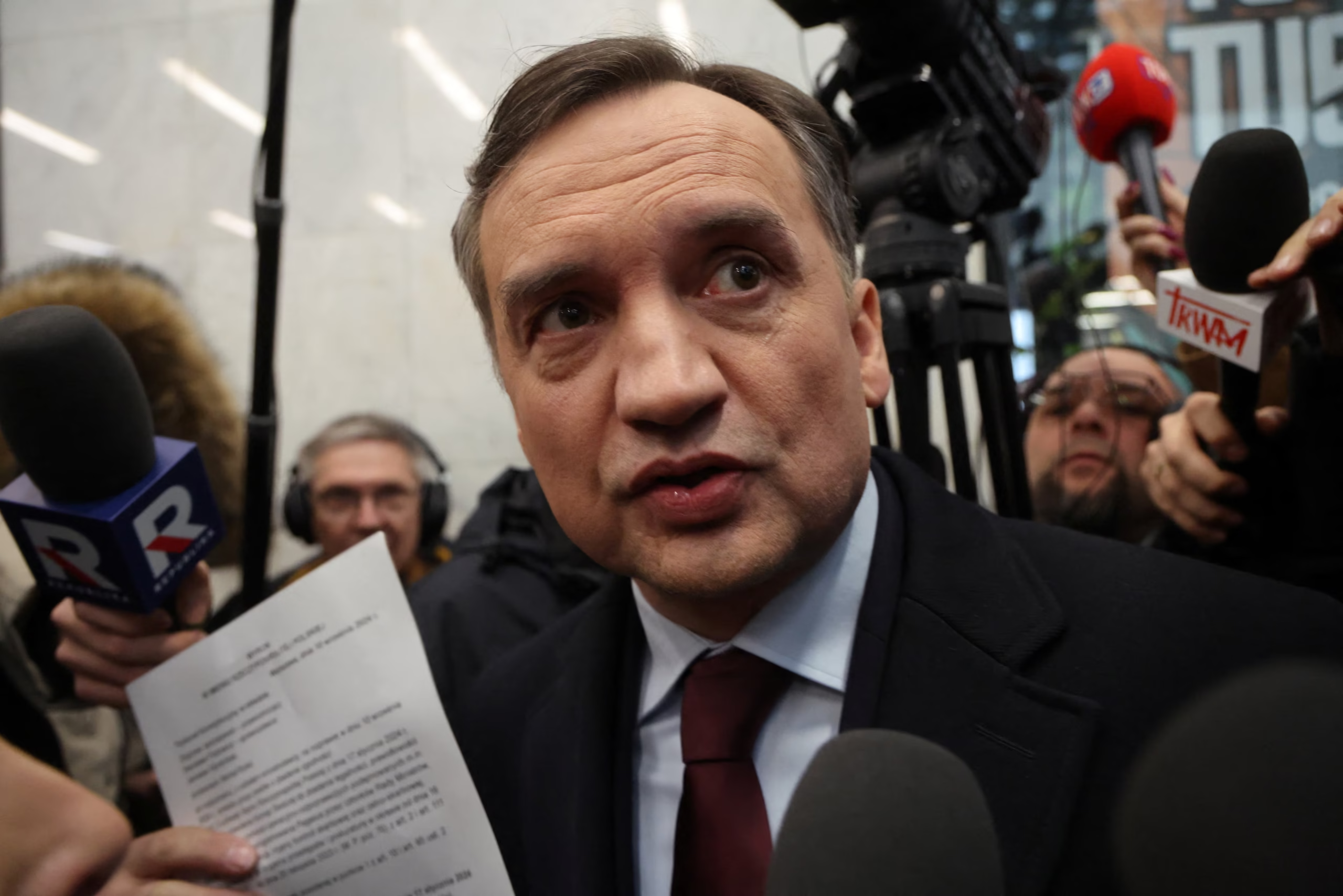

Poland has formally requested the pretrial detention and extradition of former Justice Minister Zbigniew Ziobro from the United States, the country’s prosecutor’s office announced Monday, July 27, 2026, opening a case that could take months or years to resolve. Ziobro, who led the Justice Ministry from 2015 to 2023 under the national-conservative Law and Justice (PiS) government, faces 26 criminal charges, including running an organized criminal group, misappropriating public funds, and abuse of power.
The extradition request, transmitted through diplomatic channels, covers 19 of the 26 alleged offenses. Prosecutors accuse Ziobro of leading a scheme that diverted roughly 150 million zloty ($39.4 million) from the state’s Justice Fund — money intended for crime victims — to purchase Israeli surveillance software and fund initiatives with a political rather than victim-support purpose.
The request follows a lengthy legal process. Parliament lifted Ziobro’s immunity from prosecution in late 2025, and a Warsaw court upheld a request to place him in pretrial detention in early July 2026 after rejecting his appeal, a step prosecutors said was necessary to support the extradition case even though it is not formally required by treaty. Court spokeswoman Anna Ptaszek said at the time that the most serious charges had been substantiated, while stressing the ruling did not determine guilt or innocence.
Ziobro left Poland for Hungary after losing his parliamentary immunity, where the government of then-Prime Minister Viktor Orbán granted him political asylum. He left Hungary for the United States in May 2026, the day Orbán’s successor, Péter Magyar — who had pledged to revoke the asylum status of Ziobro and his former deputy, Marcin Romanowski — was sworn in. Hungary has since formally revoked Ziobro’s refugee status, and Poland has canceled his passports, leaving him without valid travel documents. Romanowski’s own whereabouts remain unknown, according to reporting reviewed for this article.
Reuters has reported, citing its own sources, that U.S. Deputy Secretary of State Christopher Landau personally instructed senior State Department officials to facilitate and approve a visa allowing Ziobro to travel to the US — an account that rests on Reuters’ sourcing alone and has not been corroborated by a second independent outlet in this review. Polish officials, including Justice Minister Waldemar Żurek, have separately said they contacted U.S. Immigration and Customs Enforcement seeking an explanation for the legal grounds of Ziobro’s continued presence in the country. Prime Minister Donald Tusk has called the visa approval “outrageous.”
Ziobro has rejected the allegations, describing the criminal probes and parliamentary investigations as a politically motivated campaign led by Tusk’s governing coalition. Following the extradition request, he wrote on social media that he trusts the independence of U.S. institutions and is prepared to have the case reviewed by American authorities.
How long the U.S. extradition process will take, and whether it will succeed, is unclear: Polish officials have said such proceedings between the two countries have historically ranged from months to several years and often fail. The full extradition request, reported to run to roughly 300 pages, has not been made public in detail, and the specific evidentiary basis for each of the 19 covered charges has not been independently examined for this article.